From the Story Box.
This gets complicated; bear with me.
First! We have a Bright Pink Card inserted after Plan B‘s card (working title Media Res — submitted to Del Rey in July 1989, rejected and left to languish), which puts it directly before Local Custom.
Text of the Bright Pink Card:
CORRECTION. There are 80
Lee & Miller collaborations
as of May 24 2017.
Local Custom & Scout’s Progress were not included because,
at the time they were written, they were “Sharon’s Projects”
. . . that’s a little, but not a lot, misleading. I wrote both books “by myself,” insofar as any writer living with another writer, even if they’re not admitted co-authors, may be said to have written anything “by themselves.”
That said, and Casting My Mind Back to the the early 1990s…
Steve would have been working as sysop-and-mobile unit for the Maine Meeting Place, a state-wide bulletin board that connected Maine people with disabilities for the first time. It was a very demanding job — lots of hours and travel.
I … was working mornings as a secretary, and afternoons as a reporter for The Town Line and for the Morning Sentinel. And in my spare time, I wrote. I wrote Gunshy and Barnburner, two Maine based half-cozy mysteries that were roundly rejected by Everybody. That being so, I decided to try something else, and write a Regency. Only — I didn’t want to do the research, despite that my friend eluki (aka Rosemary Edghill), who had written and seen published several Regencies, sent me books and held herself ready as a resource. There was, after all, this Perfectly Good Universe that I knew Far Better than Research would ever teach me about London during Prinny’s years of misrule, so I decided to set my Regencies on Liad.
In this, I was encouraged by my partner, and after a brief tussle, by eluki, who pointed out, not inaccurately, that Regencies were an easier sell than space opera.
From which we learn that my primary motivation in writing is not money.
Local Custom was basically written to amuse myself — I had no expectation that it would ever see publication. On those evenings when neither of us had to work, I would read what I had written since the last time to Steve, and I occasionally mailed chapters to eluki, for her amusement, as well.
Which brings us to the story card for Local Custom, proper. I’m going to paraphrase this, because the card is … something of a Piece of Work.
It says here that Local Custom was completed on November 18, 1992, at 96,000 words (I had, at eluki’s suggestion, removed Chapter 40 from the submission copy), and sent to our/my agent. Agent called a few days later, the result of which conversation was sending another manuscript, this with Chapter 40 included, bringing the entire manuscript to 98,000 words.
Our agent started her work, submitting the manuscript first to Del Rey, which rejected it on June 3, 1993
It went next to Bantam/Spectra, and news of its rejection reached me on June 2, 1994.
In January 1995, it went to Tor; the editor there called me on November 22, 1995 to say that he “liked it a lot,” and would be returning it.
In December, a submission was made to Baen Books, and in April (having, I suppose, not heard from Baen), the manuscript was sent to DAW, which rejected it, as per our usual experience with DAW, by return mail.
At which point, I withdrew Local Custom from the competition for publication, and the manuscript languished in a file drawer until it was sold as part of that famous seven-book package to Meisha Merlin, in February 1998.
In 2001, it was part of the package that Ace purchased for mass market publication, and in March 2004, Buzzy Multimedia purchased audio rights.
One more thing, not noted on the card — when it came time for Meisha Merlin to publish, Stephe Pagel, he being the publisher and in charge of such decisions, called us and said, “Yanno? Nobody’s going to want these side books. We’re just going to publish them as an original omnibus, for the folks who want everything you do.”
So it was that Local Custom (immortalized by Stephe as “the book where nothing happens”) and Scout’s Progress were published together under omnibus title Pilots Choice, joining Agent of Change, Conflict of Honors, and Carpe Diem as the Liaden books that have never had a single-title hardcover release.
Oh, about that “Nobody will want these side books?”
Pilot’s Choice sold out in two weeks and had to be reprinted.
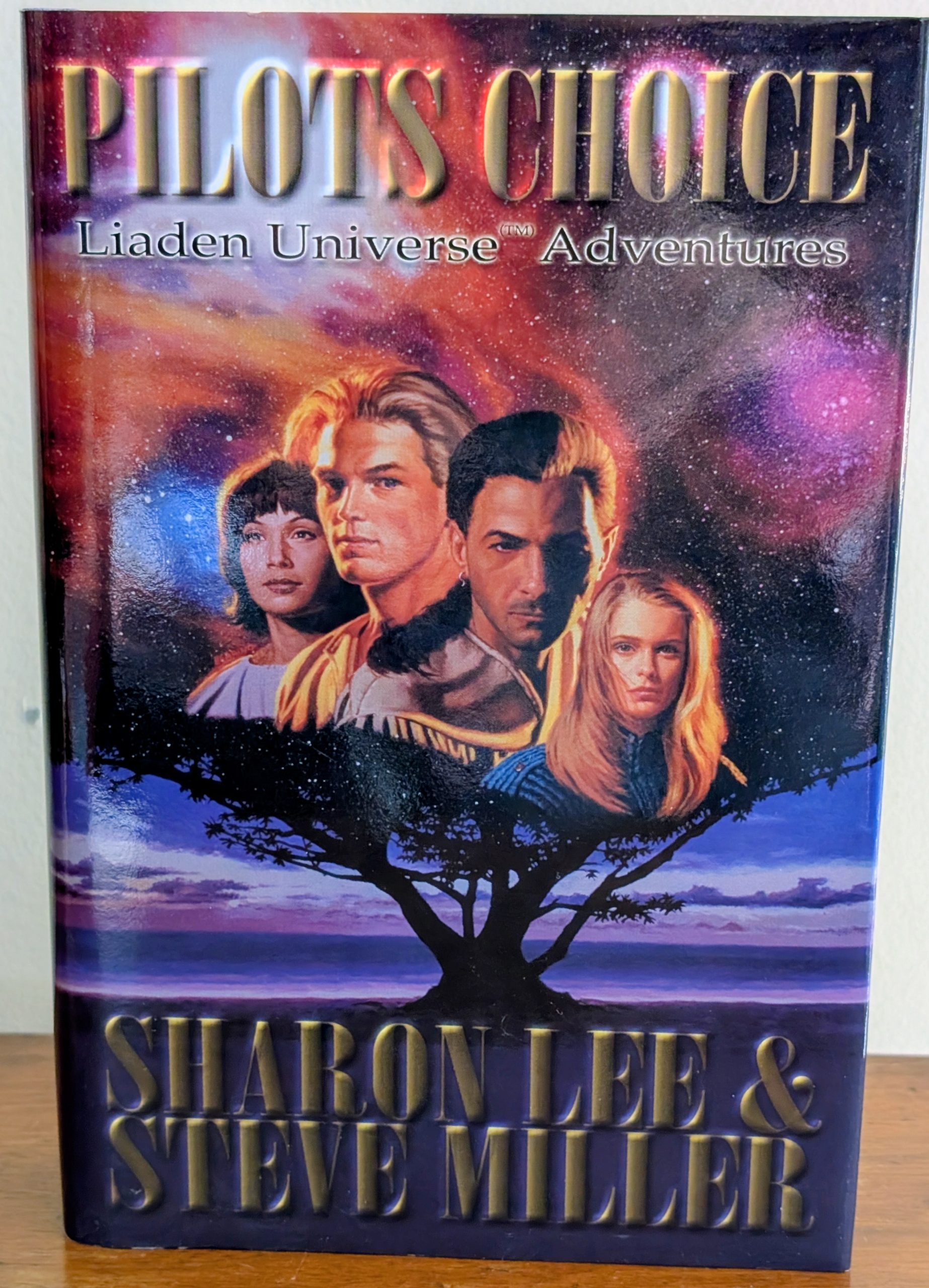 Pilots Choice art by Michael Herring.